
Resilient institutions start with resilient people: how EU4PFM integrates mental health support into strengthening institutional capacity
Public Finance Management reform in Ukraine is taking place under unprecedented pressure on state institutions. War, economic strain, and the constant need for rapid decision-making significantly increase the demands placed on the civil service.
In this context, the effectiveness of public governance goes beyond procedures and regulatory frameworks. It is directly linked to the ability of people – civil servants – to work consistently, make sound decisions, and ensure the continuity of the state’s core functions.
-
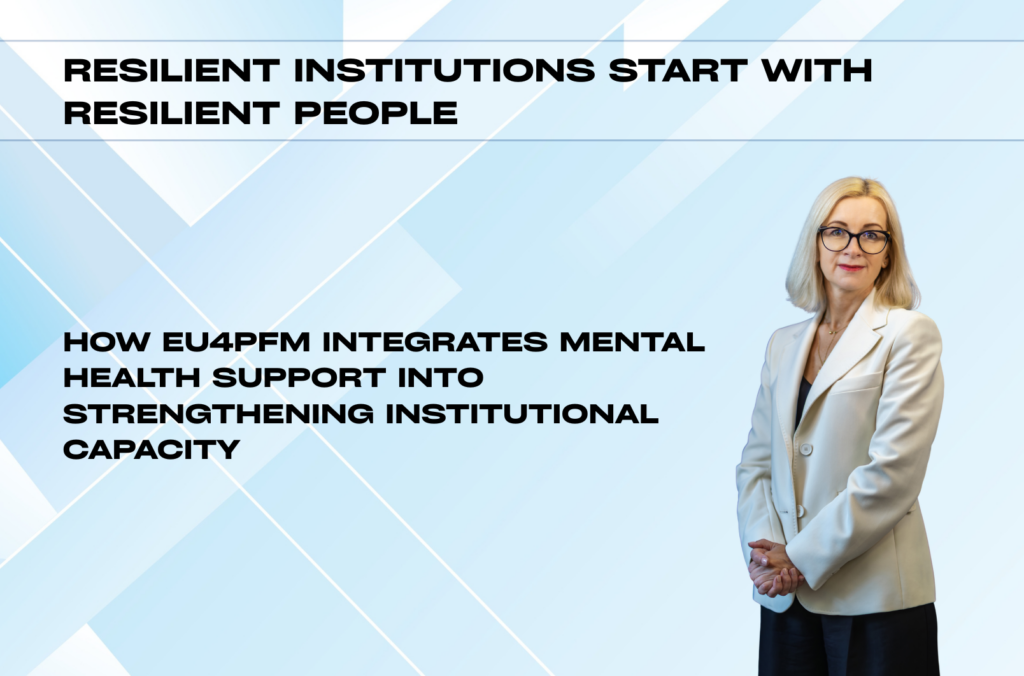
- Jurgita Domeikiene, Team Leader of EU4PFM Components 1,3,4, International Key Expert on HR/PAR
Traditionally, reform support programmes focus on policies, procedures, and management tools. However, practice shows that even the most well-designed solutions cannot deliver results without sufficient institutional capacity to implement them.
In the context of European integration, this takes on particular importance, as one of the key objectives of the EU4PFM Programme is to support Ukraine on its path to EU membership. This means that not only laws, procedures and IT systems should be aligned with the European Union regulations, but, crucially, institutions and the people should be prepared and ready to work with a new reality.
Institutional capacity therefore includes not only professional competencies, but also the ability to operate under sustained pressure, adapt to change, and maintain the quality of decision-making in times of crisis. Strengthening this capacity at the human level is thus a key prerequisite for the sustainable advancement of reforms and successful European integration.
Prolonged stress and overload directly affect these capacities – reducing productivity, complicating coordination, and increasing the risk of management errors. Supporting mental health, therefore, is not a separate “social initiative”, but an integral component of ensuring the stability and effectiveness of state institutions.
As part of its cooperation with partner institutions, the EU4PFM Programme is also supporting the enhancement of human resources (HR) management in Public Finance Management institutions. Drawing on EU best practices, this work supports partners in developing a sustainable, competency-based and strategically oriented human resource management for the public finance management system .
The HR units is often the first point of contact for employees facing professional or personal challenges. Today, one of the most common requests from civil servants towards HR experts is the need for mental health support. In response, and with the aim of strengthening both knowledge and practical skills in this area, the Programme initiated dedicated training activities, even though this topic goes beyond its formal mandate.
This is why EU4PFM has integrated mental health support into its activities as an element of strengthening the institutional capacity of partner institutions.
A practical step: training for partner institutions
In this context, EU4PFM delivered a series of training sessions on mental health and emotional wellbeing for staff of the Ministry of Finance of Ukraine, the State Tax Service of Ukraine, and the State Customs Service of Ukraine.
More than 850 participants from across the country took part. These training sessions marked the first systemic step towards integrating psychological resilience into cooperation with partner institutions. The content was tailored to the practical needs of civil servants working under high levels of responsibility, limited resources, and pressure. Participants received practical tools to recognise stress factors, manage workload, and sustain performance over the long term.
One of the key approaches introduced during the training was reframing stress as a management factor. This involves not only reducing its negative impact, but also identifying early signs of burnout, balancing workload and resources, and maintaining an optimal level of productivity. In this context, skills such as self-regulation, task prioritisation, and time management are seen as core professional competencies of a civil servant.
Preventing burnout as a matter of institutional resilience
Burnout is not only an individual issue, but also a systemic risk for organisations. Its consequences may include loss of expertise, reduced quality of decision-making, disruption of process continuity, and increased pressure on other teams. In wartime conditions, these risks are amplified and can directly affect the ability of institutions to perform their functions.
This is why early identification of signs of exhaustion and the introduction of basic support practices are becoming part of organisational risk management.
During the training, both individual tools and the broader institutional context were addressed. This includes fostering a culture of responsible workload management, introducing effective planning practices, and developing management approaches that take the human factor into account. Such changes not only reduce the risk of burnout, but also enhance overall team performance.
Scaling support: an open video course
To expand access to practical tools, EU4PFM experts also developed an open-access video course on mental health, consisting of eight short lessons. The course offers simple, practical tools for coping with stress, building resilience, and maintaining personal resources to prevent burnout, as well as guidance on building healthy relationships within teams.
The course is available here (EU4PFM Youtube).
This format allows participants to integrate learning into their daily work without interrupting their professional duties.
Supporting reform through strengthened capacity
EU4PFM continues to support Ukraine in strengthening its Public Finance Management system and advancing its European integration agenda. In this process, it is becoming increasingly clear that the sustainability of reforms and the success of European integration depend not only on the quality of policies, but also on the capacity of people to implement them.
Integrating mental health support is a response to the real challenges currently faced by state institutions. It is not an additional strand of work, but an investment in their ability to function consistently and effectively. This includes, in particular, the stability of public authorities, the quality of management decisions, and the long-term impact of reforms.